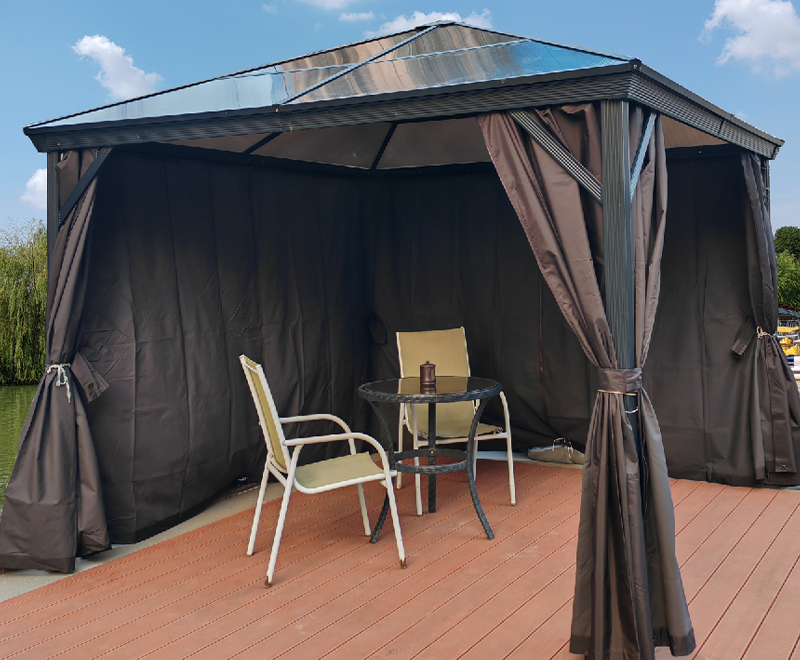
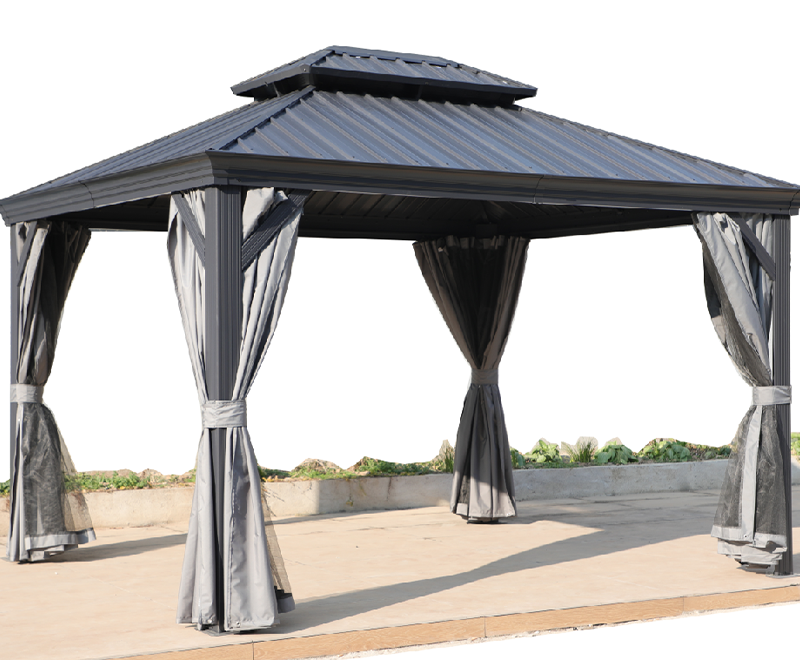
Anchoring a gazebo is the step most people rush, and it is the step that decides whether the frame is still standing after a windy week. A gazebo is essentially a large sail balanced on four or six small feet: the roof catches the wind, the frame pushes that force down the posts, and everything depends on how firmly those posts are fastened to whatever sits underneath them. The good news is that anchoring a gazebo is not complicated. You need to know which surface you are building on, choose hardware that suits it, and tighten everything in the right order. Below are the methods that hold up best on concrete, pavers, decking, grass, and gravel, along with the shortcuts that quietly fail.
A 10 x 12 gazebo roof offers well over 100 square feet of surface to the wind. At 30 mph that is already hundreds of pounds of upward force on the frame, and in a real storm the numbers climb fast enough to lift a unit that feels immovably heavy when you push on it by hand. Weight helps, but it is not a substitute for anchoring, because the wind is working on the roof rather than the base. Even all-aluminum frames hold up better when the footplates are fixed down, since a light frame can shift as one piece.
Anchoring also does quieter work. It keeps the base square so doors, screens, and sliding panels still line up after a season of frost, rain, and ground movement. Many warranties exclude wind damage on a unit that was never secured, and a gazebo that tips into a fence or a neighbour's property becomes a liability question nobody wants to answer.
Before buying hardware, look at what sits under the base plates. Every surface holds an anchor differently, and the wrong combination can crack a paver or pull straight out of loose gravel.
| Surface | Best anchor type | Drilling required | What to watch for |
|---|---|---|---|
| Concrete slab | Wedge or sleeve anchors | Yes | Strongest hold; use the footplate holes as a template |
| Interlocking pavers | Long concrete screws through the paver into the base below | Usually | Never rely on the paver itself; it will crack or rock |
| Wood decking | Lag or carriage bolts into the joists | Yes | Find the joists first and seal every hole |
| Grass or soil | Auger or helical ground anchors | No | Drive stakes at an angle for extra grip |
| Gravel or crushed stone | Timber base frame or concrete footings | No | Loose material offers almost no holding power |
| Asphalt | Asphalt anchors with a wide base plate | Yes | Check local rules before drilling |
Concrete gives the strongest hold, and it is the surface most permanent hardtop models are designed for.
Aim for at least one anchor per post, and more on larger models or in exposed, windy locations.
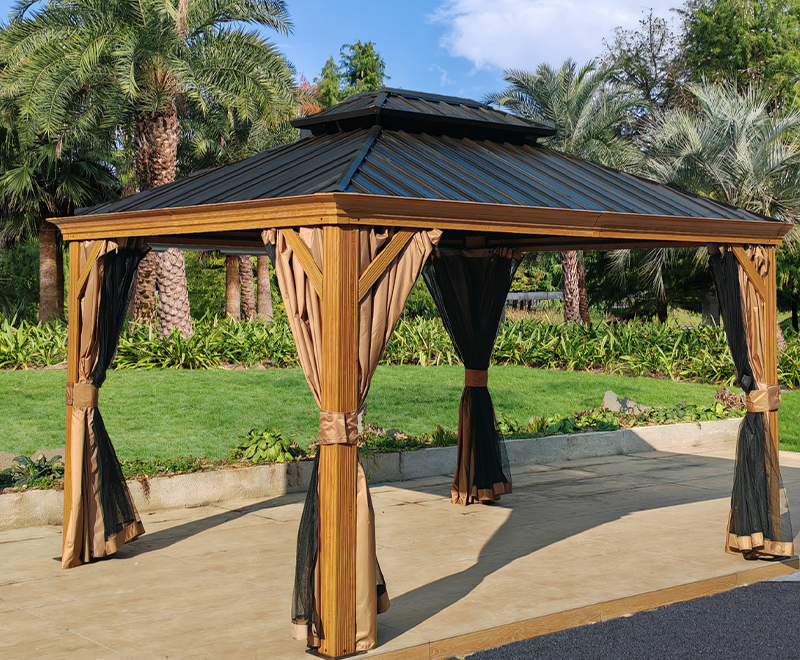 Custom Hardtop Gazebos and PergolasCompare polycarbonate, metal roof, and double roof hardtop gazebos in sizes from 3x3m to 12x16ft when planning anchoring.View Product →
Pavers and timber decking look solid but behave differently. Individual pavers sit in a sand or gravel bed and can rock, so an anchor that grips only the paver will either crack it or work loose within a season.
Two approaches work well. The first is to drill through the paver and into the concrete or compacted base below, then use a long concrete screw so the load transfers past the paver. The second is to build a small timber or concrete footing frame on top of the pavers and bolt the gazebo to that, spreading the weight across several pavers instead of one. If neither is practical, stakes driven beside the base plates and strapped to the frame will hold a lighter unit, though not in a storm.
Lag bolts or carriage bolts driven through the deck boards into the joists give a reliable hold. Locate the joists first with a stud finder or by lifting a board, and seal each hole afterwards so water does not get into the timber.
Loose ground has very little holding power, so the goal is either to reach below the soft layer or to spread the load sideways.
Gravel and crushed stone sit at the difficult end of the scale, because the material simply slides around an anchor. Plan on a timber base frame, a paved pad, or concrete footings rather than relying on stakes.
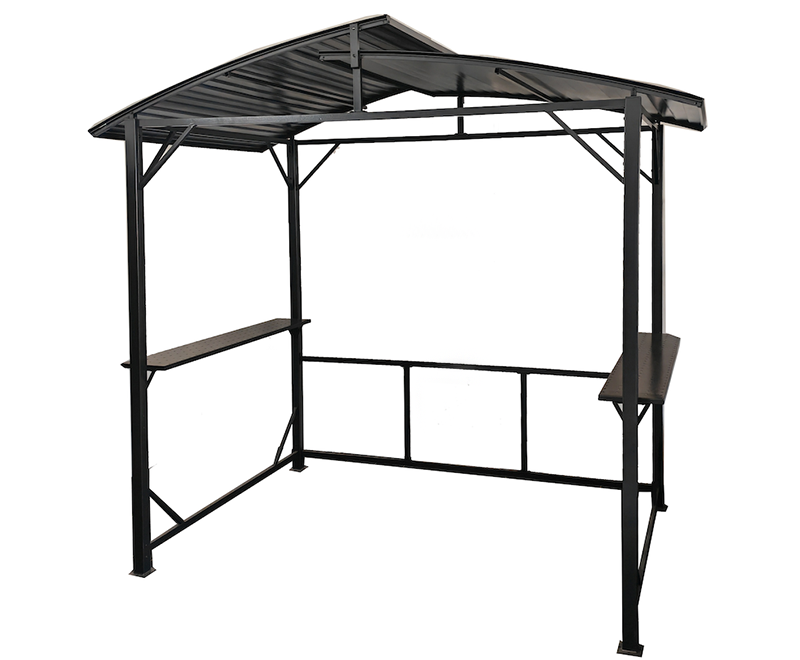
 JJ1089 Waterproof Outdoor Barbecue ShedA 2.5 x 1.5 x 2.5m barbecue shelter with galvanized steel roof and waterproof side curtains, relevant when securing smaller grill structures.View Product →
If you cannot drill, you can still make a gazebo much safer. Weighted bases, sandbags, and heavy planter boxes set on the base rails are the usual starting point, and they work well for pop-up canopies and smaller grill structures used through the summer. Ratchet straps tied to ground screws or to a fence post add resistance, and auger stakes can be pulled out at the end of the season without leaving a mark.
Be realistic about the limits, though. No-drill methods suit light, temporary structures. They are not a substitute for proper anchoring on a large hardtop gazebo that will be left standing through winter.
Walk around the gazebo twice a year, ideally before storm season. Push each post sideways and look for movement at the base plate, then tighten anything that has loosened. Clear debris from the anchor points so water does not pool around them, and watch for rust staining near the bolts. If a post has shifted enough that the roof panels no longer sit flush, re-level the frame before tightening, because pulling a twisted frame straight with anchors only adds stress.
Anchoring is far easier when the structure was designed for it. Our hardtop gazebos and sunrooms use powder-coated metal frames with pre-drilled footplates, so the base tells you exactly where the bolts go and the coating keeps the hardware area from rusting through. Panels are formed on our own roll lines and finished on our own powder line, which means replacement parts for a frame that has been up for years are a phone call away rather than a full replacement.
Wall-mounted models are anchored in two directions: into the wall behind them and into the ground at the front posts. That is why we always check the wall type and the surface below before matching a model to a space, since a cavity wall and a solid brick wall need very different fixings.
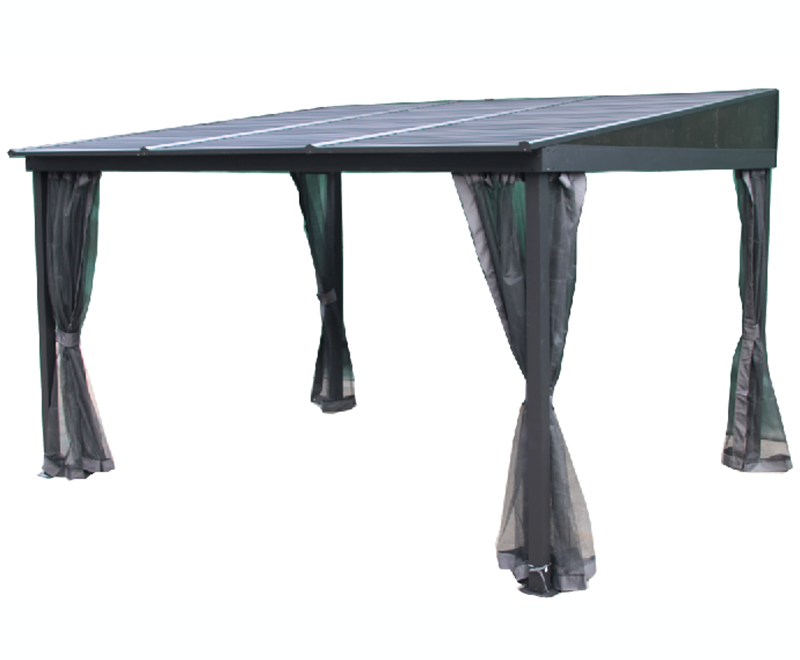 Custom Wall-Mounted Gazebos and Sun ShedsTwo 3x3.6m wall-mounted sun shed options with sliding or iron plate roofs, useful when checking wall structure before choosing fixings.View Product →
Good anchoring is invisible when it is done properly and obvious when it is not. Pick the method that matches your surface, use hardware that will still be sound in five years, and check it once a season. That is the whole secret.

The company has 20 professional and technical personnel and more than 200 company employees; it covers an area of 15,000 square meters. We are an enterprise specializing in the production, design and sales of metal products.
No. 137-1, Zhangjia, Shangtian, Fenghua, Ningbo, China
justin.gao@vip.163.com
+86-13867888253
OEM/ODM Hard Top Tent/Shelter Manufacturers
Copyright © Ningbo Jinjin Leisure Co., Ltd. All Rights Reserved.

 English
 中文简体
 Français