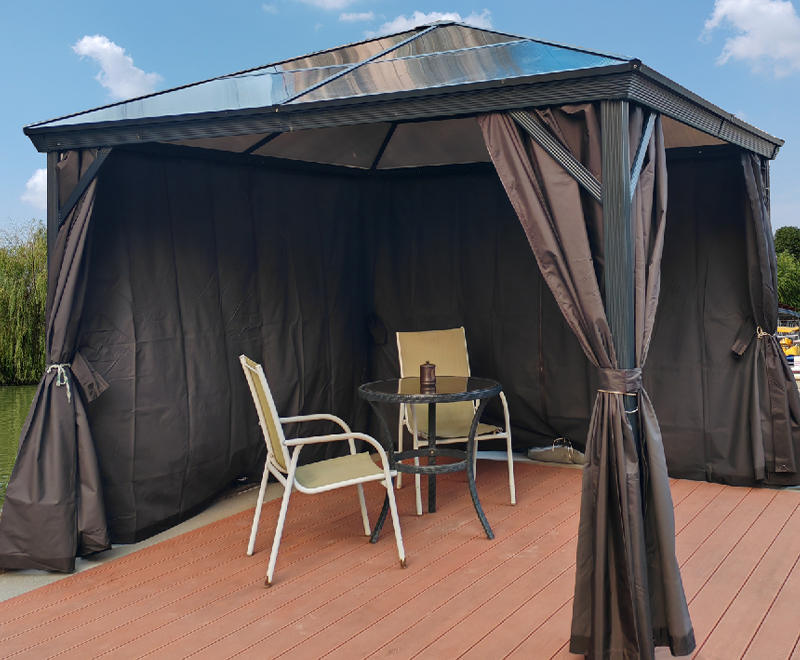
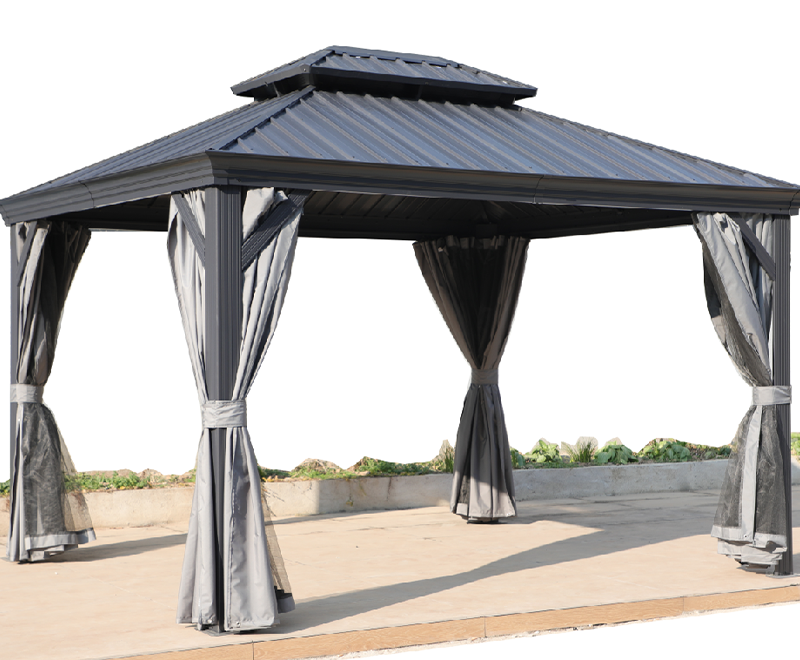
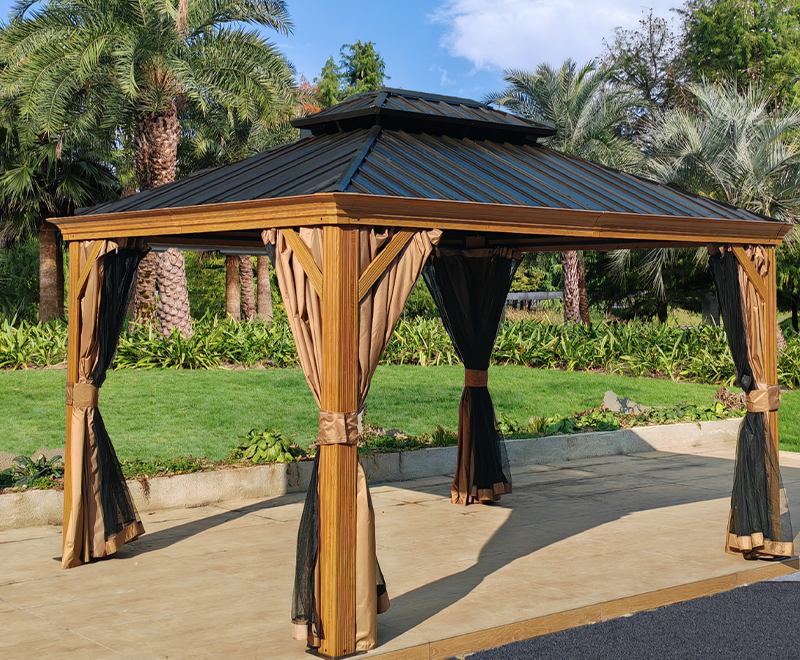
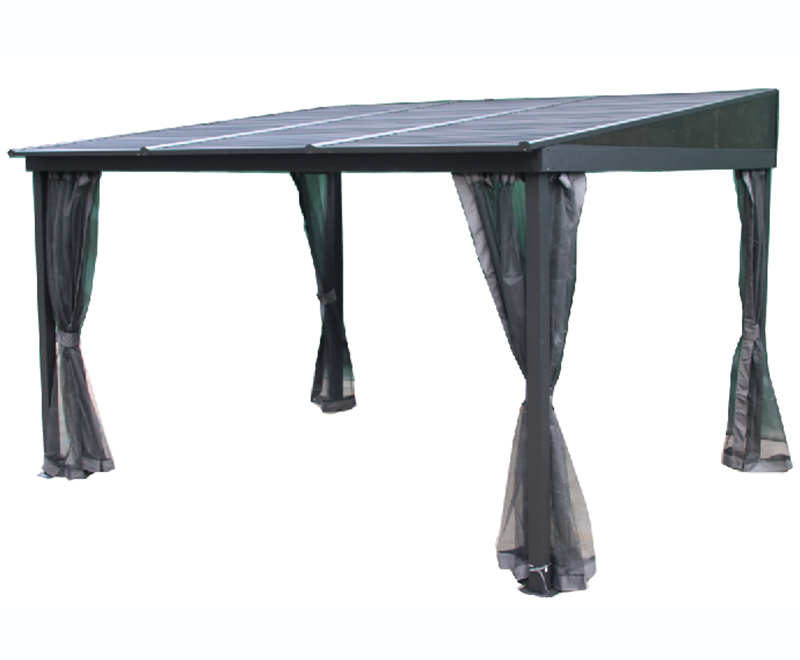
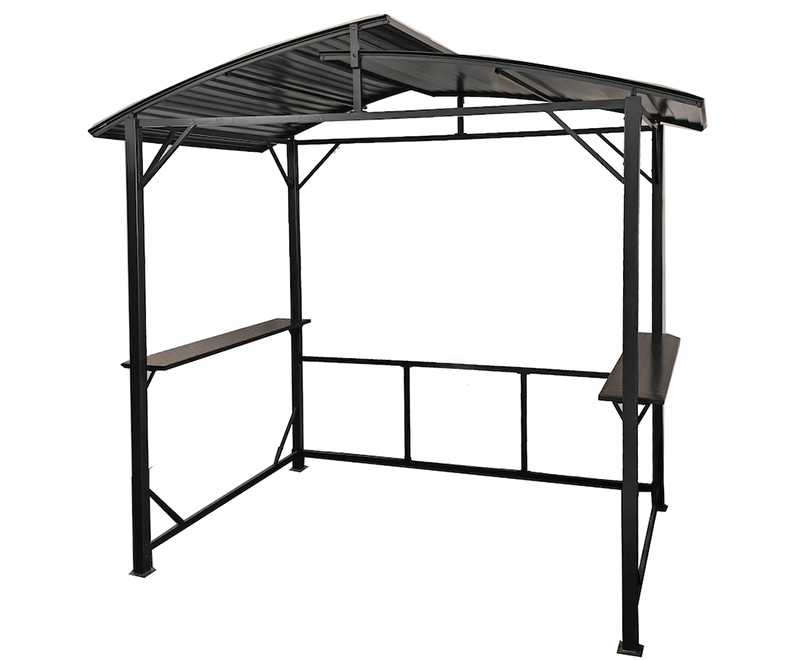
You have decided to add shade to your patio, deck, or backyard. A gazebo seems like the perfect solution—protection from the sun, a defined outdoor room, and a boost in property value. But then you discover there are two main types: wall-mounted gazebos (also called attached gazebos or lean-to gazebos) and freestanding gazebos (standalone structures with four or six posts). Which one is right for your space? The answer depends on your patio layout, budget, local building codes, wind exposure, and how you plan to use the shaded area. Understanding the key differences between a wall-mounted gazebo and a freestanding gazebo will help you make an informed choice that provides years of comfortable outdoor living.
The fundamental difference between these two gazebo types is right in the name. One attaches to an existing wall; the other stands entirely on its own.
A wall-mounted gazebo (also known as a lean-to gazebo, attached gazebo, or wall-anchored pergola) is secured to the exterior wall of a house, garage, or other building. It typically has two support posts at the outer corners, with the back edge bolted directly to the wall via a ledger board. The roof slopes away from the wall to shed water. Wall-mounted gazebos are essentially permanent additions to your home.
Key characteristics:
A freestanding gazebo is a completely independent structure. It has its own foundation (concrete footings, deck blocks, or a gravel base) and its own support posts—typically four, six, or even eight. It does not touch the house or any other building. You can place it anywhere on your property as long as the ground is level or can be graded.
Key characteristics:
| Feature | Wall-Mounted Gazebo | Freestanding Gazebo |
|---|---|---|
| Attached to house | Yes | No |
| Number of posts | 2 (typically) | 4–6 |
| Roof slope | Single slope (lean-to) | Multi-slope (hip, pyramid, or dome) |
| Foundation required | Wall anchors + post footings | Full foundation (footings or slab) |
| Can be relocated | No | Yes (with difficulty) |
| Typical footprint | Rectangular, up to 12 ft projection | Square, rectangular, hexagonal, octagonal |
Your available space and how you want to use it will heavily influence which type works best.
Wall-mounted gazebos excel in specific spatial situations:
Narrow or small patios: If your patio is only 10–12 feet deep from the house to the yard, a freestanding gazebo would take up most of that space and block access. A wall-mounted gazebo uses the house as one side, leaving the rest of the patio open.
L-shaped or irregular spaces: Attaching to a wall allows you to create a shaded area that follows the building’s footprint without needing posts in awkward locations.
Existing covered patio extension: If you already have a covered patio but want to extend the covered area further into the yard, a wall-mounted gazebo is the natural choice—it continues the roofline outward.
Small urban backyards: In tight city lots, every square foot counts. A wall-mounted gazebo adds shade without consuming valuable yard space with four posts and a full foundation.
Maximum projection from wall: Most wall-mounted gazebos project 6 to 12 feet from the wall. Beyond 12 feet, the structural demands on the ledger board and outer posts become significant, requiring engineering.
Freestanding gazebos are better for:
Large, open yards: If you have a spacious backyard, a freestanding gazebo can become a destination—a place to gather away from the house, perhaps near a garden, pool, or fire pit.
Island seating areas: Placing a gazebo in the middle of a patio creates a focal point. You can walk completely around it, which feels more like a separate “room” than an attached structure.
Uneven ground away from house: If the best shaded spot is 30 feet from the house, a wall-mounted gazebo cannot reach that far. A freestanding gazebo can be placed exactly where you want it, regardless of distance from the building.
Rental properties or temporary installations: While not truly portable, a freestanding gazebo can be disassembled and moved if you relocate. A wall-mounted gazebo leaves permanent holes and a ledger board attached to the house.
| Gazebo Type | Minimum patio depth | Minimum width | Ceiling clearance needed |
|---|---|---|---|
| Wall-mounted | 8 ft (to allow walking under) | 8 ft | 7 ft at outer edge (sloped roof) |
| Freestanding (8x8 ft) | 10 x 10 ft area | 10 ft | 7–8 ft at center |
The engineering behind each type is significantly different. This affects durability, wind resistance, and installation complexity.
A wall-mounted gazebo relies on three main structural elements:
Ledger board: A pressure-treated or aluminum beam bolted to the house wall. This carries half the roof load (the side closest to the house). The ledger must be bolted into wall studs or masonry with appropriate anchors.
Two outer posts: Located at the outer corners of the gazebo. These posts support the outer edge of the roof. They must be set in concrete footings or on adjustable post bases attached to a concrete pad.
Rafters or roof beams: These span from the ledger board to a header beam that connects the two outer posts. The roof slopes downward from the house (typically 1/4 inch per foot or more).
Critical considerations:
A freestanding gazebo is a self-supporting structure. It typically has:
The entire load—roof weight, snow, wind, and any hanging items (fans, lights)—is transferred down through the posts to the foundation. No part of the load goes to the house.
Critical considerations:
| Gazebo Type | Wind Resistance | Weak Point |
|---|---|---|
| Wall-mounted | Moderate (typically 90–110 mph rating) | Ledger board connection; outer post uplift |
| Freestanding (4-post) | Good (100–120 mph with proper anchoring) | Post-to-foundation connection |
| Freestanding (6+ posts) | Excellent (120+ mph) | None specific |
In hurricane-prone areas, freestanding gazebos with properly reinforced posts are generally preferred over wall-mounted designs, which create a lever arm that can damage the house wall.
The foundation work differs dramatically between the two types.
Because a wall-mounted gazebo attaches to the house, the foundation requirements are typically less extensive:
Total concrete needed: Approximately 4–8 bags (80 lb each) for the two footings, plus optional pad.
A freestanding gazebo requires a full foundation system:
Total concrete needed: 8–20 bags for footings alone; 1–3 cubic yards for a full slab (significantly more labor and cost).
| Foundation Aspect | Wall-Mounted | Freestanding |
|---|---|---|
| Number of footings | 2 | 4–6 |
| Digging required | Minimal (2 holes) | Moderate to extensive |
| Concrete volume | Low (4–8 bags) | Moderate to high (8–20+ bags) |
| Requires structural engineer? | Sometimes (for ledger) | Rarely (unless very large) |
| Can be built on existing patio? | Yes (cut holes for footings) | Yes, but posts must go through patio to ground |
Costs vary by size, materials, and whether you hire a contractor or DIY. However, general patterns emerge.
Lower initial material cost: Because you use the house as one wall, you need fewer posts, less roofing material, and less framing. A 10x10 wall-mounted gazebo uses two posts; a 10x10 freestanding gazebo uses four posts.
Higher installation complexity: Attaching to the house requires careful flashing, waterproofing, and anchoring. Mistakes can lead to water damage inside your walls.
Potential hidden costs: You may need to hire an electrician to move exterior lights or outlets that conflict with the ledger board. You may need a structural engineer to verify the wall can support the load.
Typical cost range (DIY): $800–2,500 for materials (pressure-treated wood or aluminum)
Typical cost range (professional install): $3,000–8,000 including labor and permits
Higher material cost: More posts, more rafters, more roofing, and a full foundation system.
Lower installation complexity (on flat ground): No wall attachment means no flashing, no waterproofing against the house, and no risk of interior water damage. However, you must still dig footings.
Potential hidden costs: If your yard is not level, you may need grading or retaining walls. Large gazebos may require engineered drawings.
Typical cost range (DIY kit): $1,500–5,000 for a prefabricated kit (wood or metal)
Typical cost range (custom build): $5,000–15,000+ for larger or premium materials
| Cost Factor | Wall-Mounted | Freestanding |
|---|---|---|
| Materials (basic) | Lower | Higher |
| Labor (DIY-friendly) | Less friendly (wall attachment tricky) | More friendly (no wall work) |
| Permit complexity | Higher (attached to house) | Lower (unless large) |
| Foundation cost | Lower (2 footings) | Higher (4–6 footings) |
| Long-term maintenance | Similar | Similar |
This is where the two types diverge significantly. Most jurisdictions treat attached structures differently than freestanding ones.
Because a wall-mounted gazebo is attached to the house, it is almost always considered an “addition” or “accessory structure attached to a dwelling.” This triggers:
Typical permit cost: $100–500
Freestanding gazebos often have simpler requirements, but it varies by size:
Typical permit cost: $0–300 (often free for small structures)
| Permit Aspect | Wall-Mounted | Freestanding |
|---|---|---|
| Permit typically required? | Yes (almost always) | Only if over size limit |
| Structural engineering needed? | Often | Rarely |
| Setback requirements | Same as house | Less restrictive |
| Increases property tax assessment? | Yes (permanent addition) | Possibly (depends on local rules) |
Both types provide shade, but the pattern and timing differ.
Because a wall-mounted gazebo is attached to the house and has a single-slope roof, the shade it casts is directional:
The shade is deepest near the house and shallower at the outer edge. The roof slope affects how far the shade extends.
A freestanding gazebo with a pyramid or hip roof casts shade in a circle or polygon around it:
| Aspect | Wall-Mounted | Freestanding |
|---|---|---|
| Shade coverage area | Rectangular, adjacent to house | Circular/polygonal, centered on gazebo |
| Shade moves during day | Yes, but anchored to house | Yes, but moves around gazebo |
| Best for fixed seating near house | Yes | Possibly (if gazebo placed near house) |
| Best for seating away from house | No | Yes |
The visual impact of each type differs significantly.
A wall-mounted gazebo becomes part of your home’s architecture. It extends the roofline and creates a transition between indoors and outdoors. Design considerations:
A freestanding gazebo is a landscape feature. It stands alone and draws the eye. Design considerations:
| Aesthetic Factor | Wall-Mounted | Freestanding |
|---|---|---|
| Becomes part of house | Yes | No |
| Can be seen from all sides | No (back is against house) | Yes |
| Suitable for corner of yard | No (needs wall) | Yes |
| Classic gazebo look (octagonal) | No | Yes |
Use this decision flow to choose between a wall-mounted and freestanding gazebo.
Some homeowners create a hybrid: a freestanding gazebo placed very close to the house (6–12 inches away), with a small gap. This provides the independence of a freestanding structure (no wall penetration, easier permitting) but still feels connected to the house. A roof connector or awning can bridge the gap.
| Feature | Wall-Mounted Gazebo | Freestanding Gazebo |
|---|---|---|
| Attachment to house | Yes (ledger board) | No |
| Number of posts | 2 | 4–6 |
| Foundation complexity | Low (2 footings) | Moderate to high (4–6 footings) |
| Permit difficulty | High (attached structure) | Low to moderate |
| Wind resistance | Moderate | Good to excellent |
| Typical cost (DIY) | $800–2,500 | $1,500–5,000 |
| Typical cost (installed) | $3,000–8,000 | $5,000–15,000+ |
| Best for small patios | Yes | No |
| Best for large yards | No | Yes |
| Classic gazebo appearance | No (lean-to style) | Yes |
| Can be relocated | No | With difficulty |
| Shade pattern | Fixed adjacent to house | Moves around gazebo |
Q1: Can I convert a freestanding gazebo into a wall-mounted gazebo?
Not easily. A freestanding gazebo is designed with four or more posts and a balanced roof structure. Removing two posts and attaching the remaining structure to a wall requires significant re-engineering of the roof, rafters, and beam connections. It is usually cheaper to build a new wall-mounted gazebo than to modify an existing freestanding one.
Q2: Does a wall-mounted gazebo require a building permit in all areas?
Almost always, yes. Any structure attached to a house is considered a permanent addition and triggers building code review. Even small wall-mounted awnings often require permits in strict jurisdictions. Check with your local building department before purchasing materials. Fines for unpermitted attached structures can be substantial, and you may be forced to remove the gazebo.
Q3: Can I install a wall-mounted gazebo on a vinyl-sided house?
Yes, but you must cut away the vinyl siding where the ledger board attaches and install proper flashing. The ledger board must bolt into the structural wall sheathing and studs behind the siding. Do not attach the ledger directly to vinyl siding; the siding is not structural. Hire a contractor experienced with siding and flashing if you are not comfortable with this work.
Q4: Which type is better for high-wind coastal areas?
A well-anchored freestanding gazebo with six posts and deep concrete footings generally performs better in high winds than a wall-mounted gazebo. The wall-mounted design creates a lever arm that can pry the ledger board away from the house. In hurricane-prone areas (wind speeds over 110 mph), many building codes restrict or prohibit attached structures unless they are engineered specifically for wind loads.
Q5: Can I add mosquito netting or screens to both types?
Yes. Both wall-mounted and freestanding gazebos can be fitted with mosquito netting. For wall-mounted gazebos, you attach the netting to the house wall at the back and to the two outer posts at the front. For freestanding gazebos, you attach netting to all posts. Track systems (similar to sliding screen doors) work well for both. Retractable screens are also available.
Q6: How close to the property line can I place a freestanding gazebo?
Setback requirements vary by jurisdiction. Typical setbacks for freestanding accessory structures (sheds, gazebos) are 3–5 feet from side property lines and 5–10 feet from rear property lines. Attached structures (wall-mounted gazebos) must usually meet the same setbacks as the house itself, which are often larger (10–15 feet). Always check your local zoning code.
Q7: Does a wall-mounted gazebo damage the house over time?
If installed correctly with proper flashing, membranes, and corrosion-resistant fasteners, a wall-mounted gazebo should not damage the house. If installed poorly, water can seep behind the ledger board, rotting the sheathing and framing. Use Z-flashing above the ledger, caulk the top edge, and ensure all bolts are sealed. Inspect the ledger connection annually for signs of water intrusion or movement.
Q8: Can I install a ceiling fan or lights in a wall-mounted gazebo?
Yes, but the installation is different from a freestanding gazebo. In a wall-mounted gazebo, you can run electrical wiring from the house through the exterior wall and into the gazebo’s roof cavity. This is often easier than running power to a freestanding gazebo, which may require trenching and buried conduit. However, any electrical work requires a permit and licensed electrician in most areas.
Q9: Which type adds more value to my home?
A well-designed, professionally installed wall-mounted gazebo that matches the house architecture typically adds more value because it becomes a permanent addition (like a covered patio). Freestanding gazebos are considered “accessory structures” and may add less value, though a high-end octagonal gazebo with power and screens can still be a selling point. Both add value if they are in good condition and match the neighborhood aesthetic.
Q10: Can I build a wall-mounted gazebo on a second-story deck?
Yes, but this requires engineering. A second-story deck must be designed to support the additional weight of the gazebo (roof, posts, potential snow load). The ledger board must attach to the house wall above the deck. You will almost certainly need a structural engineer and a building permit. Many jurisdictions have specific codes for elevated attached structures. Do not attempt this as a DIY project without professional guidance.

The company has 20 professional and technical personnel and more than 200 company employees; it covers an area of 15,000 square meters. We are an enterprise specializing in the production, design and sales of metal products.
No. 137-1, Zhangjia, Shangtian, Fenghua, Ningbo, China
justin.gao@vip.163.com
+86-13867888253
OEM/ODM Hard Top Tent/Shelter Manufacturers
Copyright © Ningbo Jinjin Leisure Co., Ltd. All Rights Reserved.

 English
 中文简体
中文简体 Français