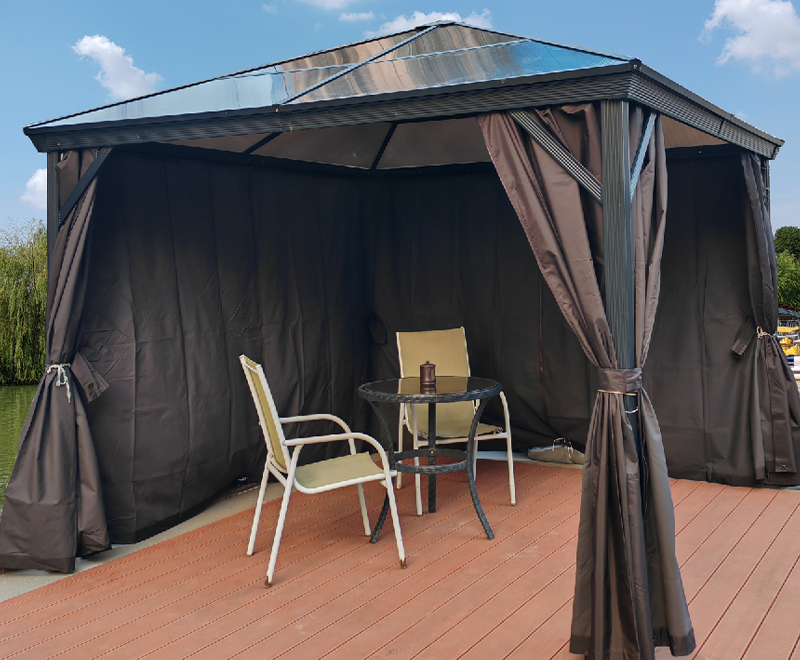
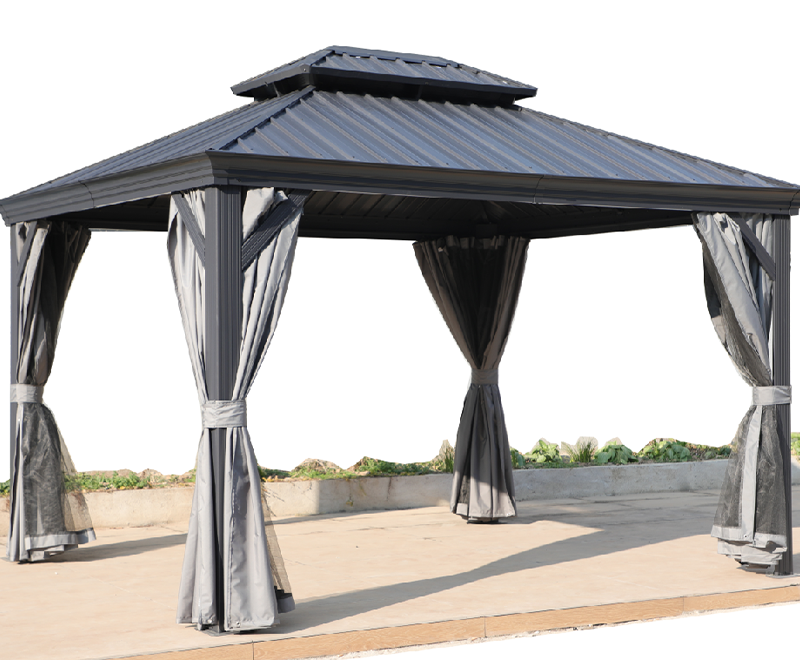
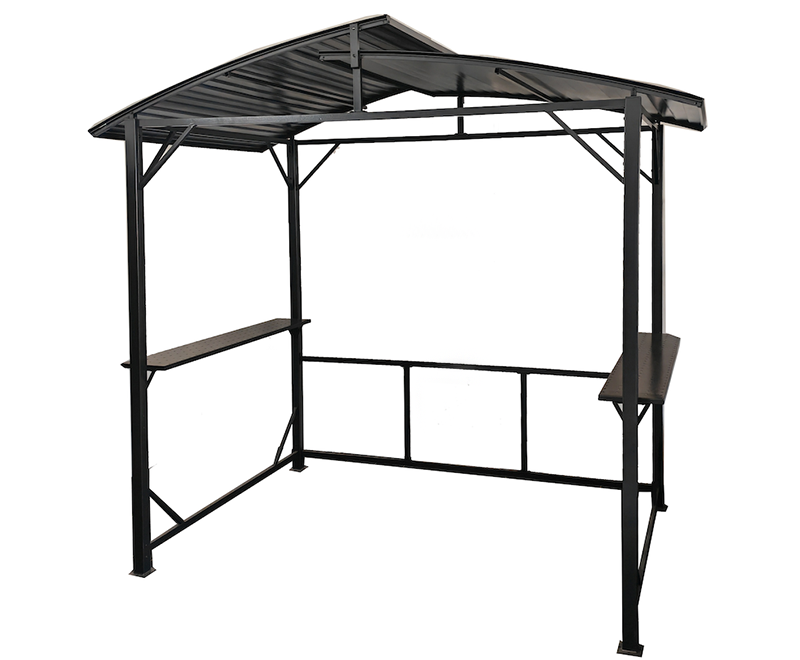
Most of the gazebos that leave our workshop in Ningbo begin life as a coil of zinc-coated steel. Buyers ask us about galvanized steel gazebos for a very practical reason: they have watched a painted frame survive two or three wet seasons and then start pushing rust bubbles up through the finish. Galvanizing changes the order in which things fail. The zinc goes first, slowly and predictably, and the steel underneath stays intact. What follows is what we have learned about the coating itself, where it stops helping, and the details worth checking before you commit to a container load.
On an outdoor structure, the word covers three quite different processes, and the difference matters more than the label.
Pre-galvanized steel is the most common route. Zinc is applied to the flat steel coil at the mill, and the strip is then roll-formed into square tube, cut, punched and welded. Coating weights are quoted as Z120, Z275 and similar, or on the older G-scale, where G90 works out to roughly 275 g/m2 of zinc. Most gazebo frames on the market sit somewhere between Z120 and Z275.
Hot-dip galvanizing happens after fabrication. Finished parts are dipped in molten zinc, so the coating reaches the inside and outside of every tube and seals the cut ends. It is heavier, more expensive, and usually reserved for coastal or industrial projects.
Electro-galvanizing is the thin one. It looks bright and smooth but offers only a few microns of zinc, which is not enough for a structure expected to stand outdoors for a decade.
Zinc protects steel in two ways at once. As a barrier, it seals the surface from moisture and oxygen. As a sacrificial metal, it corrodes in place of the steel whenever the coating is scratched, drilled or cut. A screw hole in a galvanized post does not become a rust point the way it does in painted carbon steel; the surrounding zinc feeds the exposed edge instead.
That is why galvanized frames perform so well where gazebos actually get used. Coastal air carries salt. Inland gardens deal with acid rain, fertiliser dust and months of high humidity. Under those conditions bare steel can show surface rust within a single season, while a properly coated galvanized frame typically holds its structure for fifteen to twenty years.
Zinc is not unlimited, though. It is consumed slowly, and consumption speeds up wherever water sits. The weak points in any gazebo are the joints, the base plates and the hollow sections where condensation collects. Good design drains those areas; poor design hides them.
Material choice is really a question of which failure mode you can live with. The table below summarises how the common options behave in a garden setting.
| Frame material | How it resists rust | Weight | Upkeep | Best suited to |
|---|---|---|---|---|
| Pre-galvanized tube with powder coat | Zinc layer plus barrier film; cut edges self-protect | Moderate | Rinse once or twice a year | Most gardens, patios and volume programmes |
| Hot-dip galvanized steel | Thick zinc, decades of life even unpainted | Heavier | Almost none | Coastal, industrial and heavy snow areas |
| Powder-coated carbon steel | Barrier only; rust starts at chips and welds | Moderate | Frequent touch-up paint | Sheltered patios |
| Aluminium | No red rust, but pits in salt air | Light | Occasional washing | Coastal use when anodised or powder coated |
| Cedar or hardwood | Natural oils; rots on ground contact | Heavy | Annual oiling | Dry climates and traditional gardens |
Aluminium is lighter and never develops red rust, but it pits in salt air and flexes more in wind, so it needs thicker sections. Wood looks warm and ages gracefully, yet it needs annual oiling and rots where it touches soil. Powder-coated carbon steel is the cheapest route, and the one most likely to disappoint.
Almost every galvanized gazebo frame is also powder coated, and that second layer does more work than buyers expect. The sequence in our plant runs: alkaline degrease, two-stage rinse, a conversion coating, a dry-off oven, electrostatic powder application, then a cure at roughly 180 to 200 degrees Celsius.
Two numbers are worth asking for. Coating thickness should land between 60 and 100 microns; anything under 60 microns wears through at corners and edges. Neutral salt spray results, run to ASTM B117 or ISO 9227, should reach several hundred hours before blistering or creepage appears.
Powder coating over galvanized steel is more demanding than coating bare steel. Zinc is chemically reactive, and if the conversion coating is skipped or rushed, the powder can lift off in sheets after a season or two. That is a pre-treatment problem, not a zinc problem.
The roof is where galvanizing earns its keep. Hardtop roof panels are roll-formed from galvanized coil, and the ribs that give a panel its stiffness also trap the condensation that forms on the underside on cool mornings. A frame that breathes, with small gaps at the eaves, sloped panels and no sealed boxes, will outlast an identical frame that keeps moisture in.
Snow load and wind uplift are the two structural numbers that matter most. A double-tier or sloped roof sheds snow better than a flat one, and every fixing point should sit over a reinforced section rather than in the middle of a thin panel.
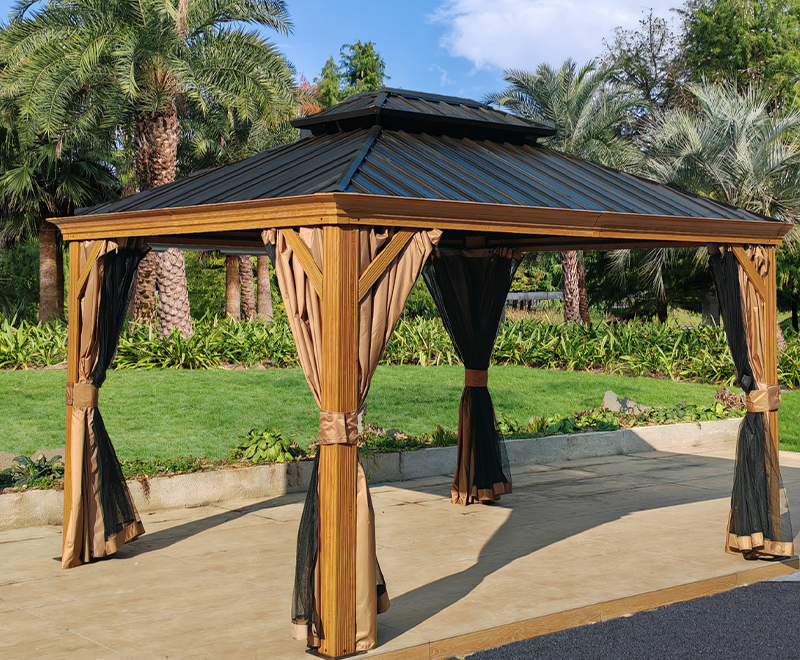 Custom Hardtop Gazebos and PergolasExplore hardtop gazebo and pergola options in polycarbonate or metal roof, including a double-roof model for better snow shedding.View Product →
If you want to see how zinc roofing behaves across a full season of use, our note on the advantages of a zinc roof covers the practical side of that question.
Not every galvanized structure needs four posts. A wall-mounted gazebo uses the house as one side, which halves the amount of steel standing in wet ground and cuts the wind load on the frame. The trade-off is flashing: water running down the wall has to be directed away from the joint where the frame meets the masonry, or the zinc is asked to do work it was never meant to do.
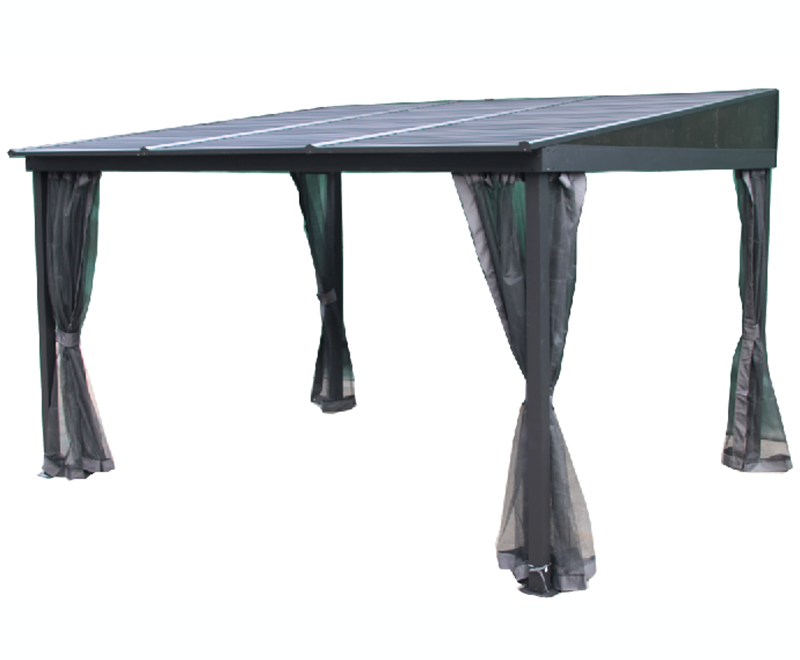 Custom Wall-Mounted Gazebos and Sun ShedsCompare two 3x3.6m wall-mounted sun sheds with sliding or iron plate roofs, a format that uses the house as one side.View Product →
Smaller steel-roofed shelters follow the same rules at a different scale. A grill gazebo sits close to the house, takes heat and grease from the cooking surface, and is often the structure a household uses most. Because the roof span is short the panels can be thinner, but the fasteners and the powder coat still need to be specified for outdoor service.
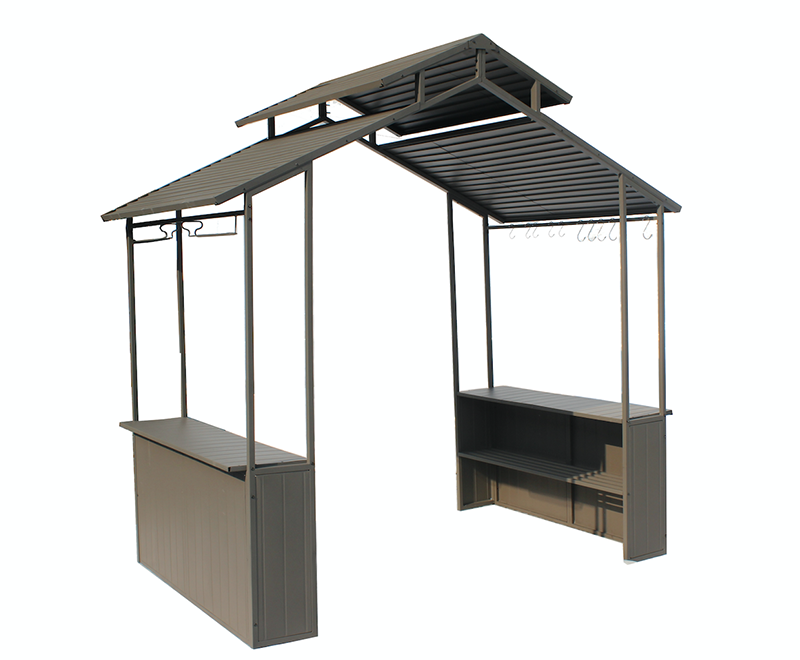 2.5m Waterproof Outdoor Barbecue ShedA 2.5 x 1.5 x 2.5m barbecue shed with galvanized steel roof and spray-painted iron frame, easy to assemble for outdoor cooking.View Product →
Galvanized steel asks for very little, but the little it asks for matters. Rinse the frame with fresh water twice a year, and quarterly if you live within a few kilometres of the sea, to wash off salt and airborne dirt. Mild soap is fine; abrasive pads and acidic cleaners are not, because they strip the powder coat and expose the zinc to faster consumption.
Walk the structure once a season. Tighten any loose bolts, check the roof seals, clear leaves from gutters and corners, and touch up chips with a zinc-rich primer before topcoating. Keep fertiliser, pool chlorine and lawn chemicals away from the base plates, and brush heavy snow off the roof rather than letting it sit there.
For importers and brand owners, the specification conversation usually starts before the design does. Zinc grade, tube thickness, powder system, packaging and container loading all interact: a heavier gauge frame that loads fewer units per container changes the landed cost more than a few cents of zinc.
As a hardtop gazebo manufacturer, our own production covers roll forming, CNC metal work, laser welding and an in-house powder coating line, with a QC team that inspects frames before and after coating. That setup is what allows us to hold a zinc specification across repeat orders instead of treating every shipment as a fresh experiment. If you are planning a galvanized range for next season, the sensible first step is to agree on coating weight and salt spray target, then design the frame around them.
Galvanized steel is not a marketing word. It is a measurable coating weight, a pre-treatment process, and a set of details around drainage and fasteners. Get those right and a gazebo frame will still be doing its job long after the cushions have been replaced twice. Get them wrong, and the rust will arrive on schedule, coating or no coating.

The company has 20 professional and technical personnel and more than 200 company employees; it covers an area of 15,000 square meters. We are an enterprise specializing in the production, design and sales of metal products.
No. 137-1, Zhangjia, Shangtian, Fenghua, Ningbo, China
justin.gao@vip.163.com
+86-13867888253
OEM/ODM Hard Top Tent/Shelter Manufacturers
Copyright © Ningbo Jinjin Leisure Co., Ltd. All Rights Reserved.

 English
 中文简体
 Français