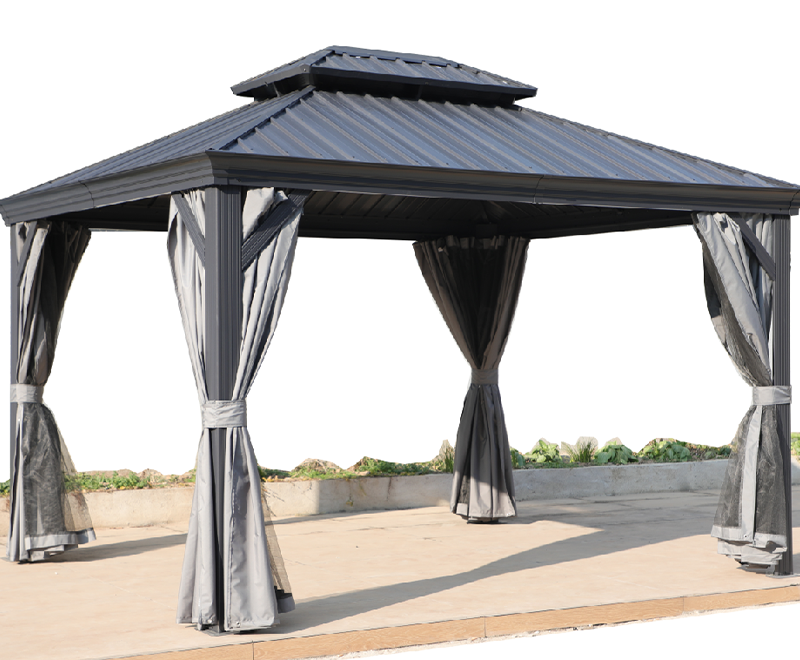
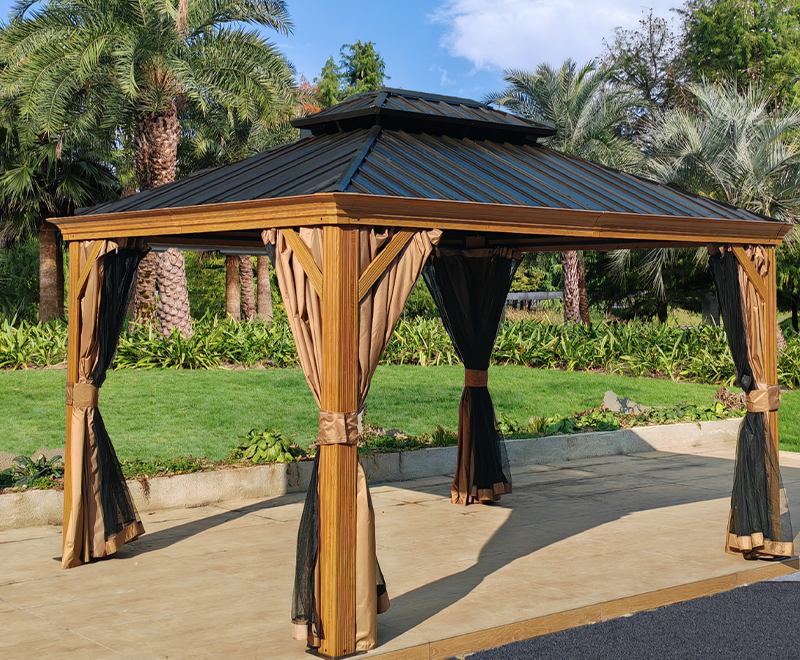
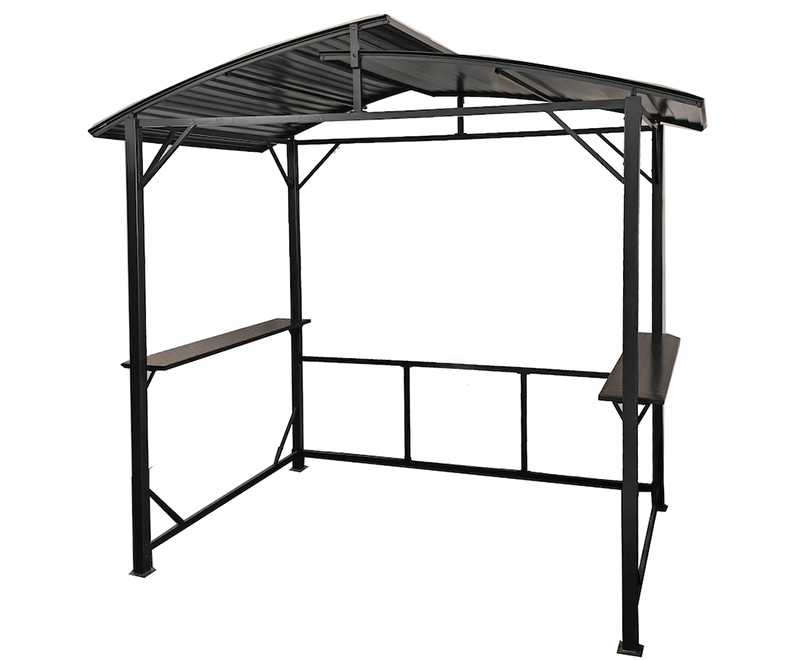
Yes — a well-built hardtop gazebo can withstand heavy rain, moderate snow loads, and significant wind speeds, but only if it is constructed from the right materials, correctly anchored, and rated for the weather conditions specific to your region. Most quality aluminum hardtop gazebos are engineered to handle wind speeds of 50–60 mph (80–97 km/h), snow loads of 20–40 psf (pounds per square foot), and are inherently waterproof by design. The difference between a gazebo that survives a decade of harsh weather and one that fails in its first storm comes down to material grade, structural design, anchoring method, and ongoing maintenance.
How Hardtop Gazebos Handle Heavy Rain
The defining advantage of a hardtop gazebo over a soft canopy is its inherent waterproofing. Unlike fabric canopies that absorb moisture, sag under water weight, and eventually leak at seams, a hardtop roof panel — whether galvanized steel, aluminum, or polycarbonate — sheds water immediately and completely.
Roof Panel Materials and Rain Performance
- Galvanized steel panels: The most rain-resistant option. A powder-coated galvanized steel roof provides a fully sealed, rigid surface with zero water absorption. Properly maintained, it will not rust or degrade from rainfall for 15–25 years.
- Aluminum panels: Naturally rust-proof and lightweight. Aluminum does not corrode in rain and handles high-rainfall climates exceptionally well. The most common material in mid-to-premium hardtop gazebos.
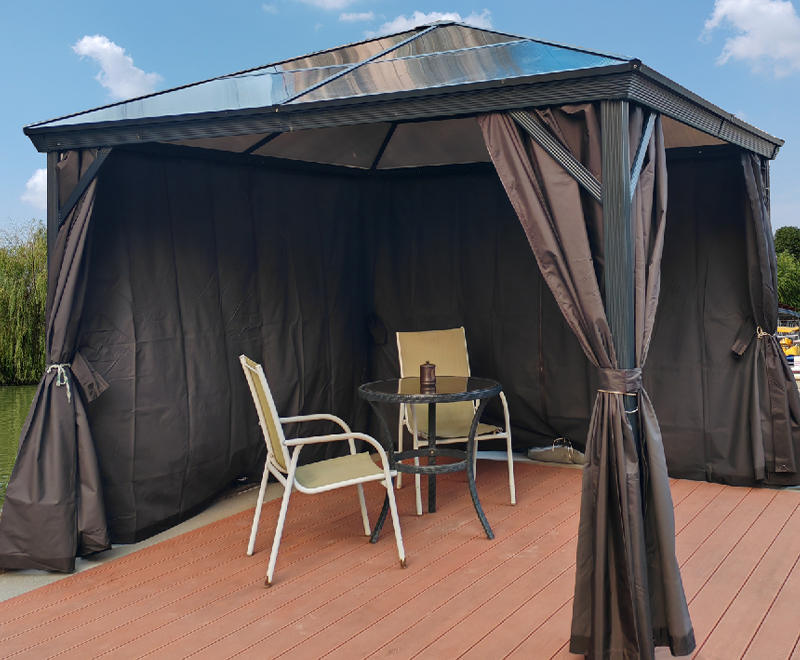
- Polycarbonate panels: Semi-transparent panels that allow natural light through while blocking rain. Rated for high-impact resistance and UV protection, but can yellow over time with prolonged sun exposure. Check for panels with UV-stabilized coating if used in high-sun climates.
- Asphalt shingles over wood frame: Found in permanent pergola-style gazebos. Fully weatherproof but significantly heavier — requires a robust concrete foundation and professional installation.
Roof Pitch and Water Drainage
Roof pitch — the angle of the roof slope — directly determines how efficiently rainwater drains off the structure. Most hardtop gazebos feature a pitch between 15° and 30°, which is sufficient for effective drainage in standard rainfall conditions. Steeper pitches (above 25°) drain faster and are preferable in regions with heavy or sustained rainfall.
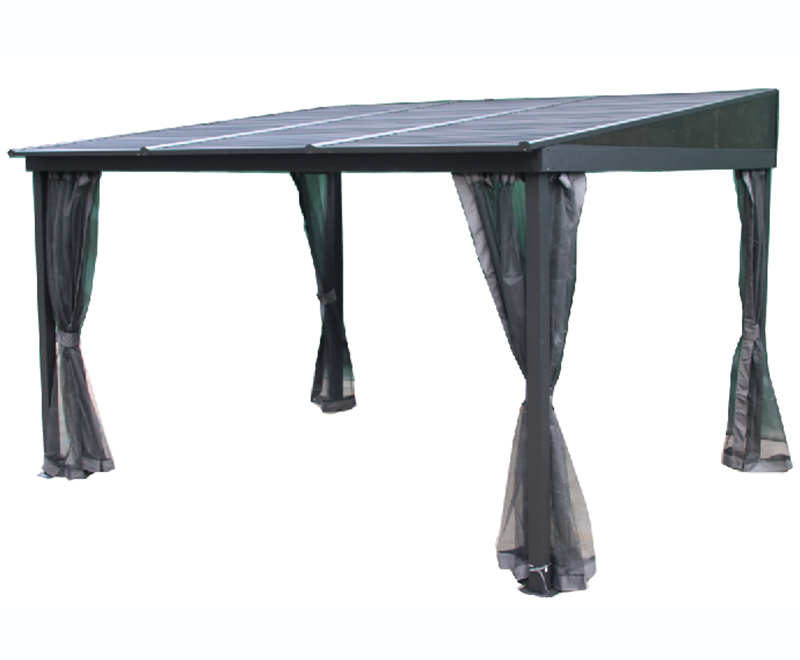
A flat or near-flat roof pitch — found in some modern minimalist designs — creates pooling risk during heavy rain and is not recommended for regions with annual rainfall above 40 inches (1,000 mm). Always verify roof pitch in the product specifications before purchasing for a high-rainfall climate.
Gutter Systems and Drainage Channels
Premium hardtop gazebos incorporate integrated gutter channels along the roof eaves that direct rainwater to the corner posts, which function as downspouts. This built-in drainage system prevents water from cascading off the roof edges onto seating areas below — a critical feature for comfortable use during rain. When evaluating products, confirm whether gutters are included or sold separately, and check that downspout outlets are positioned away from the gazebo's anchor points to prevent soil erosion at the base of the posts.
Snow Load Capacity: What the Numbers Mean and What You Need
Snow load is the weight of accumulated snow a roof structure can safely support before risking deformation or collapse. It is measured in pounds per square foot (psf) or kilopascals (kPa). Understanding this specification is critical for anyone purchasing a hardtop gazebo in a region that experiences regular winter snowfall.
How Much Does Snow Actually Weigh?
- Fresh light snow: approximately 3 psf per foot of depth
- Packed snow: approximately 12–20 psf per foot of depth
- Wet, heavy snow: approximately 20–40 psf per foot of depth — the most structurally dangerous type
- Ice layer (1 inch): approximately 5 psf — seemingly thin but significantly adds to total roof load when combined with snow above
This means that in a heavy snowfall event depositing 12 inches of wet snow, a 10×12 ft gazebo roof (120 sq ft) could be supporting up to 2,400–4,800 lbs of snow weight — well beyond the capacity of many entry-level hardtop models.
Snow Load Ratings by Climate Zone
| Climate Zone |
Typical Ground Snow Load |
Minimum Recommended Roof Rating |
Example Regions |
| Mild / No Snow |
0–5 psf |
Standard (any hardtop) |
Southern California, Florida, Texas Gulf Coast |
| Light Snow |
5–20 psf |
20 psf minimum |
Pacific Northwest, Mid-Atlantic, Tennessee |
| Moderate Snow |
20–40 psf |
40 psf minimum |
New England, Great Lakes, Colorado Front Range |
| Heavy Snow |
40–80 psf |
60–80 psf or engineered structure |
Upstate New York, Minnesota, Montana, Alaska |
Table 1: Recommended minimum snow load ratings for hardtop gazebos by U.S. climate zone
Most consumer hardtop gazebos are rated for 20–40 psf of snow load. For heavy snow regions, look specifically for models with reinforced ridge beams, thicker gauge aluminum or steel framing (at least 1.5 mm wall thickness), and cross-bracing between roof rafters. Products like the Palram Canopia Milano series and YITAHOME Pro models publish verified snow load ratings in their specifications — always confirm this data before purchasing for a snowy climate.
Roof Pitch and Snow Shedding
Steeper roof pitches naturally shed snow before significant accumulation occurs. A pitch above 25°–30° allows snow to slide off under its own weight in most conditions, reducing effective snow load on the structure. This is one of the most important passive design features for snow-prone regions — prioritize steeper-pitch models if you live where snowfall exceeds 30 inches annually.
Wind Resistance: Ratings, Frame Design, and Anchoring
Wind is the most dangerous weather condition for any freestanding outdoor structure. Unlike snow — which adds weight gradually — wind applies sudden, dynamic lateral and uplift forces that can topple or destroy an improperly anchored gazebo within seconds.
Understanding Wind Speed Ratings
Most quality hardtop gazebos publish a wind resistance rating expressed in mph or km/h. These ratings assume the structure is correctly anchored to a solid surface — an unanchored gazebo can fail at wind speeds as low as 20–25 mph (32–40 km/h).
- Entry-level hardtop gazebos: Typically rated for 35–45 mph (56–72 km/h) — adequate for calm to breezy conditions but insufficient for severe storm events
- Mid-range quality models: Rated for 50–60 mph (80–97 km/h) — suitable for most regions excluding hurricane or tornado zones
- Premium engineered models: Rated for 70–90 mph (113–145 km/h) — appropriate for coastal regions or areas with frequent severe thunderstorms
- Hurricane zones (Category 1+): Wind speeds exceed 74 mph (119 km/h) — no standard consumer gazebo is rated for sustained hurricane-force winds; these structures should be disassembled or fully secured before storm events
Frame Design Features That Improve Wind Resistance
- Post thickness and gauge: Heavier gauge aluminum or steel posts (minimum 2×2 inch cross-section with 1.5 mm wall thickness) resist lateral wind forces significantly better than thin-walled posts
- Corner bracket reinforcement: Bolted cast aluminum or steel corner brackets at roof-to-post junctions prevent racking — the lateral distortion that causes gazebo frames to collapse in high winds
- Cross-bracing: Diagonal bracing between posts at the lower frame level significantly improves resistance to lateral wind loading
- Hip roof vs. gabled roof: A hip roof (sloping on all four sides) distributes wind forces more evenly than a gabled roof (triangular ends), making it more stable in multi-directional wind events
- Lower roof profile: Gazebos with lower overall height present a smaller surface area to wind — a 9 ft peak height model will generally outperform a 12 ft peak height model in high-wind conditions
Anchoring Methods and Their Effectiveness
| Anchoring Method |
Surface |
Wind Resistance |
Notes |
| Concrete anchor bolts (epoxy set) |
Concrete / pavers |
Highest |
Most secure method; permanent installation; use minimum ½ inch diameter bolts at 3+ inch embedment depth |
| Lag screws into deck joists |
Wood deck |
High |
Must anchor into structural joists — not just decking boards; use ⅜ inch or larger lag screws |
| Ground anchor stakes |
Grass / soil |
Moderate |
Minimum 18–24 inch depth; effectiveness reduced in soft or saturated soil |
| Helical ground anchors |
Grass / soil |
Moderate-High |
Screwed into ground rather than hammered — significantly better pullout resistance than standard stakes |
| Sandbag / weight plate ballast |
Any surface |
Low |
Temporary solution only — not recommended as sole anchoring method for hardtop gazebos; suitable for soft canopies only |
Table 2: Comparison of hardtop gazebo anchoring methods by surface type and wind resistance effectiveness
Material Comparison: Which Holds Up Best in Harsh Weather?
The frame and roof material determine long-term weather resistance far more than any single structural feature. Here is how the most common hardtop gazebo materials compare across all major weather conditions:
| Material |
Rain Resistance |
Snow Load Capacity |
Wind Resistance |
Rust / Corrosion Risk |
Lifespan |
| Powder-coated aluminum |
Excellent |
Good (20–40 psf) |
Good |
None |
15–25 years |
| Galvanized steel (powder-coated) |
Excellent |
Very Good (40–60 psf) |
Very Good |
Low (if coating intact) |
10–20 years |
| Treated wood / cedar |
Good (with sealing) |
Very Good (engineered) |
Excellent (mass) |
Moderate (rot risk) |
10–30 years (maintained) |
| Polycarbonate roof panels |
Excellent |
Moderate (20–30 psf) |
Good |
None |
10–15 years |
| Budget steel (no galvanizing) |
Poor (rusts at seams) |
Poor |
Poor |
High |
2–5 years |
Table 3: Weather resistance comparison of common hardtop gazebo frame and roof panel materials
Seasonal Maintenance That Extends Weather Resistance
Even the best-built hardtop gazebo will degrade prematurely without consistent seasonal maintenance. A simple annual routine addresses the most common failure points before they become structural problems.
Before Winter (Late Autumn)
- Inspect all bolts and fasteners — tighten any loosened connections at post bases, corner brackets, and roof panel attachment points. Vibration from wind over the season gradually loosens hardware.
- Check for coating damage on steel components — touch up any chips or scratches in powder coating with matching outdoor metal paint to prevent rust initiation at exposed points.
- Clear gutters and drainage channels — remove accumulated leaves and debris that will trap water and ice during freezing temperatures.
- Apply silicone sealant to roof panel seams if any gaps have opened — prevents water ingress and ice expansion damage to panel joints.
During Winter (Snow Regions)
- Remove heavy snow accumulation promptly — use a soft-bristle roof rake or broom to clear snow after significant falls. Do not use metal tools that can scratch or dent roof panels.
- Never allow ice dams to form — ice accumulation at the eaves can weigh significantly more than snow and exerts concentrated point loads on the roof structure. Clear ice carefully with warm water rather than impact tools.
- Monitor anchor points after freeze-thaw cycles — ground movement from repeated freezing and thawing can loosen stake anchors; inspect and re-tighten after significant temperature swings.
Before Storm Season (Spring / Early Summer)
- Re-verify all anchor bolts — cold-season ground movement often requires re-tightening of concrete anchor bolts and base plate connections.
- Lubricate all moving parts — apply silicone-based lubricant to any adjustable roof vents, door hardware, or curtain rail systems.
- Inspect roof panels for micro-cracks — particularly in polycarbonate panels, which can develop stress fractures over multiple freeze-thaw cycles. Replace damaged panels before storm season to maintain structural integrity.
What to Do Before a Severe Storm or Hurricane Warning
No consumer-grade hardtop gazebo should be left unmodified in the face of a severe storm warning. When winds are forecast to exceed 60 mph (97 km/h) or a hurricane or tornado watch is issued for your area, take the following precautions:
- Remove all fabric accessories — curtains, privacy screens, and shade nets act as sails in high winds, dramatically increasing lateral load on the frame. Remove and store indoors.
- Clear the interior — remove all furniture, planters, and accessories that could become airborne projectiles or add unbalanced weight to the structure.
- Add additional tie-down straps — heavy-duty ratchet straps anchored from the roof frame to ground anchors or nearby solid structures provide significant additional uplift resistance.
- Consider partial disassembly — for gazebos in hurricane zones or with wind forecasts exceeding 75 mph (120 km/h), removing the roof panels and storing them flat is the most effective protection against catastrophic structural failure.
- Open any adjustable roof vents — if your gazebo has operable ridge vents, open them fully to allow wind to pass through rather than build up pressure beneath the roof panels.



 English
 中文简体
中文简体 Français